

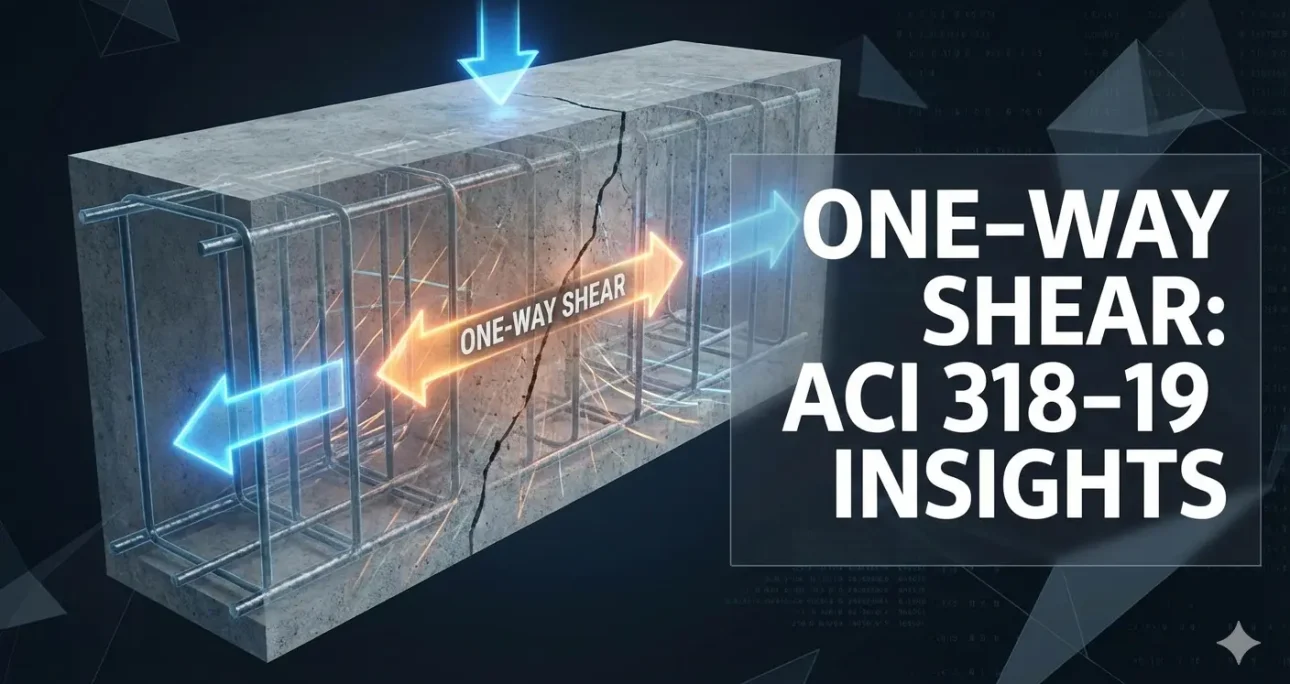
Based on the ACI 318-19 document provided, here is an organized, systematic procedure to check the one-way shear strength of sections. This summary is structured to guide you step-by-step through the calculation process.
General Design Equation
Design is based on the condition that the factored shear force (Vu) must not exceed the design shear strength (φVn):
Vu ≤ φVn
Where:
Vn = Vs + Vc
- Vc: Nominal shear strength provided by concrete.
- Vs: Nominal shear strength provided by shear reinforcement.
- φ: Strength reduction factor = 0.75 according to Chapter 21 – Table 21.2.1
Step 1: Verify Geometric and Material Limits
Before calculating strength, ensure the section and materials meet code limitations.
- Concrete Strength (√f’c): The value of √f’c used for calculation is limited to 8.3 MPa, unless minimum web reinforcement is provided.
- Yield Strength (fy, fyt): The value of fy and fyt used to calculate Vs shall not exceed 420 MPa (referenced as 20.2.2.4 limit in the text) to control diagonal crack widths.
- Effective Depth (d):
- Prestressed Members: d need not be taken less than 0.8h.
- Circular Sections: d can be assumed to be 0.8 times the diameter, and bw can be the diameter (solid section) or 2x the wall thickness (hollow section).
Step 2: Calculate Concrete Shear Strength (Vc)
Select the appropriate method based on whether the member is Non-prestressed or Prestressed.
A. For Non-Prestressed Members (Section 22.5.5)
Calculate Vc using Table 22.5.5.1. The formula depends on whether the provided shear reinforcement (Av) meets the minimum requirement (Av, min).
1. If Av > Av, min (Minimum reinforcement provided): Use the greater of (a) or (b):
$$(a)\;V_c = \left[ 0.17\lambda \sqrt{f’_c} + \frac{N_u}{6A_g} \right] b_w d$$
$$(b)\;V_c = \left[ 0.66\lambda (\rho_w)^{1/3} \sqrt{f’_c} + \frac{N_u}{6A_g} \right] b_w d$$
2. If \( A_v \le A_{v,\min} \) (No or less than min reinforcement): You must account for the size effect (\( \lambda_s\) ):
$$(c)\;V_c = \left[ 0.66\lambda_s \lambda (\rho_w)^{1/3} \sqrt{f’_c} + \frac{N_u}{6A_g} \right] b_w d$$
Key Variables:
- \( \lambda \): Lightweight concrete modification factor (1.0 for normal weight).
- \( \lambda_s \) (Size Effect Factor): \( \lambda_s = \sqrt{\frac{2}{1 + 0.004d}} \le 1 \).
- \( N_u \): Axial load (positive for compression). \( \frac{N_u}{6A_g} \) shall not exceed \( 0.05f’_c \).
- \( \rho_w \): Reinforcement ratio (\( A_s / b_w d \)).
B. For Prestressed Members (Section 22.5.6)
You may use the Approximate Method or the Detailed Method.
Option 1: Approximate Method (Table 22.5.6.2)
Applicable if \( A_{ps}f_{se} \ge 0.4(A_{ps}f_{pu} + A_s f_y) \).
- \( V_c = \left[ 0.05\lambda\sqrt{f’_c} + 4.8\frac{V_u d_p}{M_u} \right] b_w d \)
- Limits: \( V_c \) need not be less than \( 0.17\lambda\sqrt{f’_c}b_w d \) nor taken greater than \( 0.42\lambda\sqrt{f’_c}b_w d \).
- Constraint: The term \( \frac{V_u d_p}{M_u} \) shall not exceed 1.0.
Option 2: Detailed Method (Section 22.5.6.3)
\( V_c \) is the lesser of \( V_{ci} \) (flexure-shear strength) and \( V_{cw} \) (web-shear strength).
- \( V_{ci} \) (Flexure-Shear):
$$V_{ci} = 0.05\lambda\sqrt{f’_c}b_w d_p + V_d + \frac{V_i M_{cre}}{M_{max}}$$
(Minimum \( V_{ci} = 0.17\lambda\sqrt{f’_c}b_w d \)).
- \( V_{cw} \) (Web-Shear):
$$V_{cw} = (0.29\lambda\sqrt{f’_c} + 0.3f_{pc})b_w d_p + V_p$$
Step 3: Check Cross-Sectional Dimension Limit
To prevent diagonal compression failure, the code imposes a maximum limit on shear capacity regardless of reinforcement. Ensure the section is large enough:
$$V_u \le \phi (V_c + 0.66\sqrt{f’_c}b_w d)$$
If \( V_u \) exceeds this value, you must increase the cross-sectional dimensions (\( b_w \) or \( d \)) or concrete strength.
Step 4: Determine Required Shear Reinforcement (\( V_s \))
If \( V_u \gt \phi V_c \), Shear reinforcement is required.
Calculate the required nominal shear strength \( V_s \):
$$V_{s,\mathrm{required}} = \frac{V_u}{\phi} – V_c$$
Step 5: Determine Required Shear Reinforcement (\( V_s \))
Calculate the area (\( A_v \)) and spacing (\( s \)) of the shear reinforcement (stirrups) to provide the required \( V_s \).
For vertical stirrups (perpendicular to the axis):
$$V_s = \frac{A_v f_{yt} d}{s}$$
For inclined stirrups (at angle \( \alpha \ge 45^\circ \)):
$$V_s = \frac{A_v f_{yt} (\sin\alpha + \cos\alpha)d}{s}$$
Types of reinforcement permitted:
- Stirrups, ties, or hoops.
- Welded wire reinforcement.
- Spirals.